 |

Flight
Rules and Operating Procedures (2007) |
|
Flight
Rules and Operating Procedures (2007) |
1. The DFSC, Inc., is a non-profit, non-commercial hang gliding club.
2. Cloud 9 Field, LLC is Tracy and Lisa’s home and sod farm; it is not open to the public. The landing strip at Cloud 9 Field is a privately owned, private use (not public use) landing strip. All visitors, members, and guests must call 517-223-8683 and get verbal permission to come to Cloud 9 Field, LLC sod farm on every visit.
3. The DFSC flying season is May-August (daily), September-October (weekends-only). In consideration of neighbors, we will not fly before 11 AM.
4. Cloud 9 Sport Aviation, LLC is a mail order hang glider supply home business.
Membership Requirements
1. Pilots must be Draachen Fliegen Soaring Club (DFSC) members, must sign the DFSC waiver, and must be 18 years of age or older.
2. All pilots must be current USHGA regular or student members. The DFSC charges $20 for the processing of temporary (30 day) student USHGA memberships.
3. Associate (Annual) Club membership fees are $100/year. Student membership is $10/flight, and converts to an Associate membership when $100 is accrued.
4. Pilots who are new to the club may fly with the DFSC as a guest, sponsored by a regular club member, without becoming an Associate (annual) member. An individual may fly with the DFSC as the guest of a regular member on a maximum of 3 visits per season (the length of a visit is defined as a continuous 7 day period). If an individual wishes to fly with the DFSC on more than 3 visits per season, then he or she must become a regular DFSC member, as described above. Guests must be or become members of the USHGA, and must complete and sign the DFSC waiver.
Rating Requirements
1. USHGA or foreign equivalent aerotow (AT) rating required and documented by logbook and/or rating card for solo flight. Minimum of Hang II (H-2) or equivalent is also required for solo flight.
2. It is optimal for pilots new to the club or lacking current logged aerotow experience to perform a tandem check-out ride with an instructor prior to solo aerotow flights. Pilots who waive the option for a tandem check out flight may choose to take their first aerotow flights in a Falcon or other easy to tow glider. Alternatively, initial aerotow flights may be done late in the day when the air is smooth. Pilots waiving any or all of these options will be required to complete and sign an addendum to the DFSC liability waiver to this effect. Tandem instruction may be required per the discretion of the instructor, operations director (OD), DFSC board member, and/or tow pilot if a pilot demonstrates difficulty towing or tows in an unsafe fashion.
3. Pilots with minimal aerotow experience or pilots who do not tow smoothly may be required to perform additional solo flights in a training glider such as a Falcon.
4. Experienced pilots transitioning to high performance gliders or transitioning to aerotow may be required to use a vertical fin on initial flights to reduce problems with yaw oscillation.
5. The DFSC, at the discretion of an instructor, OD, DFSC board member, and/or tow pilot, reserves the right to require additional training for any pilot who demonstrates problems under tow or in free flight or who is not current (see below).
Currency requirements
1. Currency is defined as having at least 5 logged aerotow flights within the last year.
2. Pilots who are not current must inform the OD or tow pilot prior to launch, of their last aerotow flight and where it took place.
3. Pilots who are not current may be required to take a tandem check-out flight, additional training, fly a training glider, and/or fly with a vertical fin.
Fees for tows and EQUIPMENT
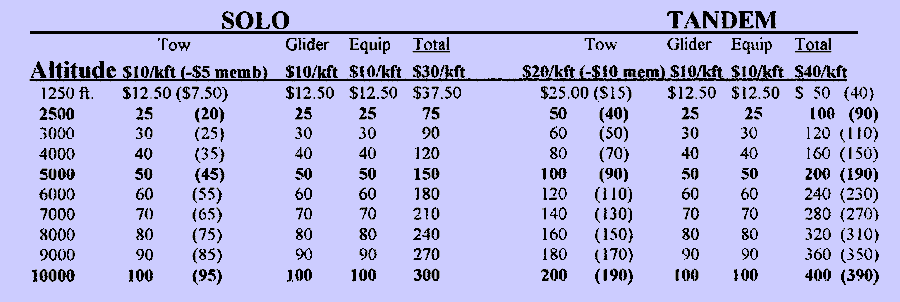
1. Please inform the tow pilot of your desired release altitude prior to launch. You can get off tow earlier, but will be charged for your requested release altitude.
2. Providers of towing and/or equipment must be authorized by the DFSC board of directors and be compensated by the DFSC. Fees are shown below. Instruction is free.
|
|
Safety Issues
1. Required Equipment
a. Helmet.
b. Steel carabiner.
c. Hang loop with backup loop.
d. Reserve parachute.
e. Aerotow bridle with primary and secondary releases (OD or tow pilot must approve).
f. Hook knife.
2. Recommended Equipment.
a. Full face helmet.
b. Wheels.
c. Stabilizer fin.
d. Use of launch cart. Individuals must obtain approval from the tow pilot or OD
prior to aerotow foot launch or hang glider wheel launch.
3. All pilots are expected to perform a careful, complete preflight on all personal and club equipment they use, and are responsible for assuring that the equipment that he/she uses is in safe condition.
4. Any pilots using unsafe equipment or demonstrating unsafe preflight or flying practices may not be allowed to fly and/or may be required to obtain additional instruction.
Flight Line Procedures
1. USHGA aerotow guidelines and sail plane-type aerotow procedures are used.
2. The OD will be in charge of flight line operations.
3. Please inform the tug pilot of your desired release altitude prior to launch.
4. First in line will be first to launch, except:
a. Tandem flights have priority and may go to the front of the line in smooth air conditions.
b. If a pilot has not competed required DFSC and/or USHGA paperwork.
c. If a pilot and his/her equipment is not ready.
5. Everyone must be familiar with the "HIERTow" prelaunch checklist:
a. Hang check: carabiner closed and locked, in leg loops, harness closed (leg doors open), hang height verified, chute and helmet secured, no loose lines or cords.
b. Instrument check: instruments and other personal equipment secured, turned on, and zeroed.
c. Equipment check: overview scan of glider (this does NOT replace a careful preflight!!) and launch cart.
d. Release check: check weak link, release function, bridle line routing (over the base tube and not twisted), location of hook knife.
e. Tow check: Verify no loose parachute, or loose lines or cords (especially VG lines or harness cords) that could get caught on the launch cart. Note wind speed and direction, scan for traffic in pattern, mentally prepare for tow and emergency actions.
Flight Procedures
1. Prior to your turn to launch: preflight your glider and equipment, wait in line just off to the side of the launch area, and be in your harness and hooked into your glider if “on deck.”
2. When your turn to launch: move to launch position, and go through the HIERTow pre-launch checklist with the OD, prior to the tug landing. Have your bridle ready to be connected to the tow rope. The command to take up slack by the OD is a low slow arm swing across the lower body. Launch command by the pilot is "GO, GO, GO!!", followed by arm circles by the OD, and an elevator waggle by the tug pilot to confirm the command.
3. At take-off: rise 10-15 feet above the ground to avoid the prop wash, maintain this altitude and wait for the tug to take off and catch up. Once the tug catches up to you, keep the wheels of the tug on the horizon until you reach 200 feet AGL, then go to a slight lower tow position in rough air (wheels somewhat above the horizon) or an even lower tow position in smooth air. Stay directly behind the tug in straight flight or slightly on the inside of the tug in a turn. If necessary, the tug pilot will signal you to maintain a higher or lower tow position. Follow his or her signals--you may “get the rope” if out of position.
4. Use yaw more that roll input techniques to avoid adverse yaw and yaw oscillations while under tow. If a pilot does not demonstrate the knowledge and ability to do this, they will be required to take additional tandem instruction, fly a training glider, and /or use a vertical fin.
5. When in doubt, release immediately. Don't try to hold on to a deteriorating situation.
6. Immediately activate your release if you experience an unexpected glider release from tow (this may be due to a weaklink break, line break, primary or secondary premature release, or release of the tow rope by the tug pilot). You must do this because you may not realize that you are dragging the rope. Whatever you do, DO NOT land with the rope!
7. While towing, don't mess around with closing your pod harness or allow yourself to do anything but concentrate fully on staying centered on tow. The tug may turn unexpectedly.
8. To signal you to release, the tug pilot will wave his or her arm up and down. The hang glider MUST ALWAYS release at this signal, just in case the tug pilot is encountering an emergency. In a normal release, the tow vehicle will dive and turn left, and the glider pilot will turn right. The tug pilot will generally try to drop you in lift (if there is any!!)
9. Your chances of staying up are better if you don't worry about closing your harness, securing you bridle line, etc., until you have found and gained altitude in a nearby thermal.
10. Circle in the same direction as other pilots in a thermal, and always look for other pilots before making a turn to avoid collision.
11. IMPORTANT: Maintain at least 1000 feet away from and do not fly directly over neighbors’ houses, or communicate verbally with individuals on the ground (some neighbors consider this offensive). Be conservative with your landing approaches. Either land back at Cloud 9 Field or land at least 2-3 miles away from the Field.
12. Prepare early for landing. Watch for traffic, no radical flight maneuvers in the pattern, land into the wind. Do not glide low over the top our buildings, the tug, or other hang gliders on the ground on your final glide to land.
13. Move your glider off of the launch/landing area ASAP (immediately, if not sooner!!)
Club Service
1. Members who perform authorized services for the club, such as maintenance, directing operations (OD), towing, etc., will receive a reduction in the cost of tow fees, at a work value of $10.00/hour for services performed.
2. The OD must be DFSC trained and authorized, and will be responsible for:
a. Verifying club membership, ratings, and currency of pilots on the flight line.
b. Collecting tow fees.
c. Establishing launch order and priority.
d. Leading pilots through the HIERTow pre launch check list.
e. Attaching the tow line.
f. Giving the signal to the tow pilot to launch.
In the absence of an OD, these tasks may be shared by the tug pilot and the hang glider pilot, if he/she is very experienced and approved of by the tug pilot.
3. Tow pilots must be DFSC authorized, and will have an ATP rating (aerotow pilot rating) from the USHGA, as well as a BFI (Basic Flight Instructor) rating from the USUA (United States Ultralight Association) or ASC (Aero Sports Connection). An exception to this will be a tug pilot who is in training and is under the direct supervision of a BFI.
4. Tow planes, launch carts, gliders and other equipment used by the DFSC must be DFSC approved and will be leased from a DFSC authorized provider. The towing and equipment provider will be responsible for all repairs, gas, and oil needed for ultralight vehicle maintenance, as well as maintenance of towing and other equipment used by the club.